

I’m going to say this plain: passing your pet off as a fake service dog so you can carry him into the grocery store is a lousy thing to do. It isn’t clever and it isn’t harmless. It’s a lie told at the expense of people with disabilities, and here in California it also happens to be a crime.
I’ve been training dogs for almost 24 years, and that includes service dogs for folks who truly need them. I’ve also been a service dog handler myself, and I’ll tell you that story in a minute. I have watched what it takes to get a dog ready for that job, and I have watched what happens to those teams when somebody’s untrained pet comes around the corner of aisle nine barking its fool head off.
So yes, I’m going to be a little hot about this one. Stick with me though, because I’m also going to give you the actual law, what a business can and can’t ask, and what it can cost you if your “service dog” does something a real one never would.
The short answer
Faking a service dog in California is a misdemeanor, and the vest protects you from nothing. If your dog bites somebody or hurts a working service dog, you pay for it. The people who pay the most, though, are the real handlers who get doubted, questioned and turned away because of the fakes who came before them.
One note before we get going. I’m a dog trainer, not a lawyer, so take this as general information and not legal advice.
Who really pays when you fake a service dog
Let’s start with the people, because that’s the part that makes my blood boil.
A person who uses a service dog isn’t out for a fun trip with their buddy. That dog is how they get through a door, cross a street, stay upright, or get warning before a medical episode hits. The dog is working, and its whole job depends on being able to concentrate in a busy place.
Now picture a pet in a vest that came off the internet, wound up tight in a store it was never prepared for, lunging and yapping at that working dog. Best case, the service dog gets pulled off task right when its person needs it. Worst case, it gets bitten, and a dog that has been attacked on the job may never work with confidence again.
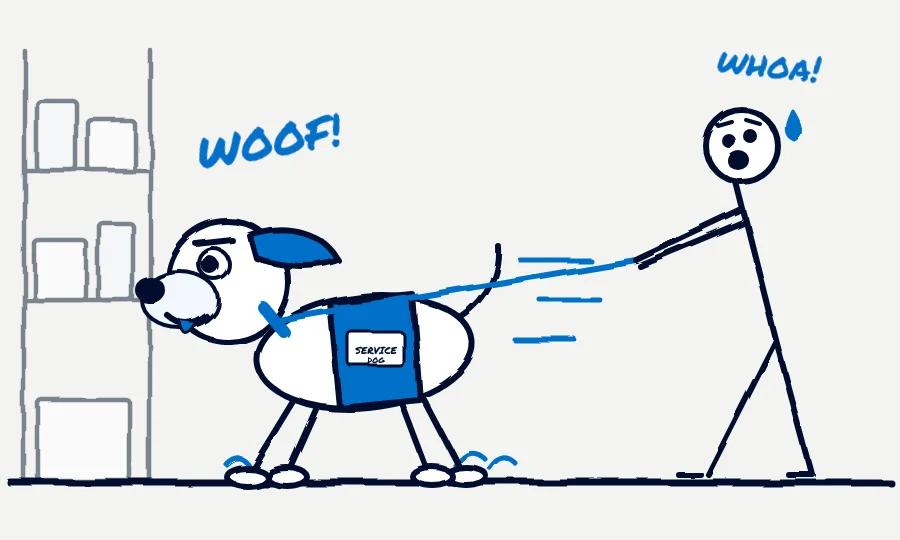
How a fake service dog affects working teams
This is not a rare thing. In a 2022 survey of 1,503 assistance dog users, 93% said they had run into poorly trained or out-of-control dogs in public, 79% said one of those dogs had snapped at, bitten, barked at, or interfered with their service dog, and 80% said it had hurt their independence and quality of life. An earlier survey of nearly 1,400 handlers found that almost half had been denied access to a business or asked to leave.
I want to be straight with you about those numbers. They count out-of-control dogs of every kind, and nobody has measured exactly how many of them were pets dressed up as service dogs. But every pet that gets walked into a no-pets store on a lie adds to that pile.
And every time a manager cleans up after one, or gets a customer bit by one, that manager looks a little harder and a little meaner at the next dog through the door. The person who catches that suspicion is the one with the real dog and the real disability, who now has to stand there and get questioned just to buy a gallon of milk.
That’s the part I find disgusting. Somebody already has a harder road than most of us, and you made it harder because you didn’t feel like leaving your dog at home for forty minutes. There isn’t a nice way to dress that up, and I’m not going to try.
I’ve been on the receiving end of this
I’m not telling you this from the cheap seats. For a stretch of my life I had a service dog of my own, a medical alert dog, for a medical situation I was dealing with, and it was very important that he be with me.
We went down to Newport Beach one day. I set up a little canopy tent and a blanket, and my dog lay under it in a down-stay right beside me. He was on leash the whole time. He wasn’t wandering the sand, he wasn’t visiting with anybody, and he wasn’t bothering a soul. All he was doing was his job, which mostly looks like a dog doing nothing at all.
A lifeguard came over and told me dogs weren’t allowed on the beach and I’d have to go. I explained he was a service dog. The lifeguard called the police, and the police tried to make me leave too.
I didn’t leave it there. I worked through it with law enforcement and the city attorneys, and in the end they agreed they had gotten it wrong and that a service dog can’t be ordered off the beach like that.
Why a fake service dog makes everyone suspicious
Now here’s what I want you to take from that story, because it’s the reason I’m writing this post. Those weren’t bad people. They spend all summer telling folks that dogs aren’t allowed on the beach, and all summer long they hear, “Oh, he’s a service dog,” from people whose dogs are plainly nothing of the kind. After enough of that, the words stop meaning anything to them. So when a real team finally shows up, with a dog lying quiet on a blanket, they’ve already made up their minds before the handler opens his mouth.
Every faker who came before me that summer had a hand in that. And it wasn’t a one-time deal, either. I’ve had the same thing happen in stores and in restaurants, all over the place, because somebody else’s dog had been in there ahead of me acting a fool under a service dog label.
So when I say fakers make life harder for people with disabilities, I’m not passing along something I read. I’ve stood there on the sand with a police officer telling me to pack up, on a day I needed that dog with me.
What actually makes a dog a service dog
Here’s where a lot of folks get tangled up, so let me lay it out.
Under the federal ADA, a service dog is a dog that is individually trained to do work or perform tasks for a person with a disability, and the task has to be directly related to that disability. That’s the whole test. A disability, and a dog trained to do something specific about it.
What surprises people is what the law does not require. There is no certificate, no registration, no ID card, and no vest, and the owner is allowed to train the dog themselves. The Department of Justice says flat out that those online registries “do not convey any rights under the ADA.” So that forty-dollar “official service dog kit” bought you a vest and a piece of paper, and neither one means a thing.
Please don’t become the service dog police
That cuts both ways, and I want you to hear the second half. Because no paperwork is required, a real service dog might be a small dog. It might not wear a vest. Its handler might look perfectly healthy to you, because plenty of disabilities can’t be seen from across a parking lot. Hassling a stranger about their dog is the very harm I’m mad about. The only thing any of us can fairly judge is how a dog behaves.
Emotional support animal
An ESA helps a person by being there, and it doesn’t need any task training. That’s a real and good thing, and California housing law makes room for it. But comfort alone is not a trained task, so an ESA has no right to go into stores and restaurants. As Disability Rights California puts it, you cannot bring emotional support animals into businesses or public places.
Psychiatric service dog
These are service dogs, full stop. The difference is training. A dog trained to notice an oncoming panic attack and do something specific about it is a service dog. A dog whose presence simply feels calming is an ESA.
Service dog in training
California is more generous than federal law here. A person with a disability or a trainer can take a dog in training out in public, but the dog has to be on a leash and wearing an assistance dog tag issued by the county or animal control. An “in training” vest by itself doesn’t cover it.
What a business can and can’t ask
If you run a shop or a restaurant in Apple Valley, Victorville, Hesperia, or anywhere else in the High Desert, this part is for you.
The two questions staff may ask
When it isn’t obvious what the dog does, your staff may ask two questions, and only these two:
- Is the dog required because of a disability?
- What work or task has the dog been trained to perform?
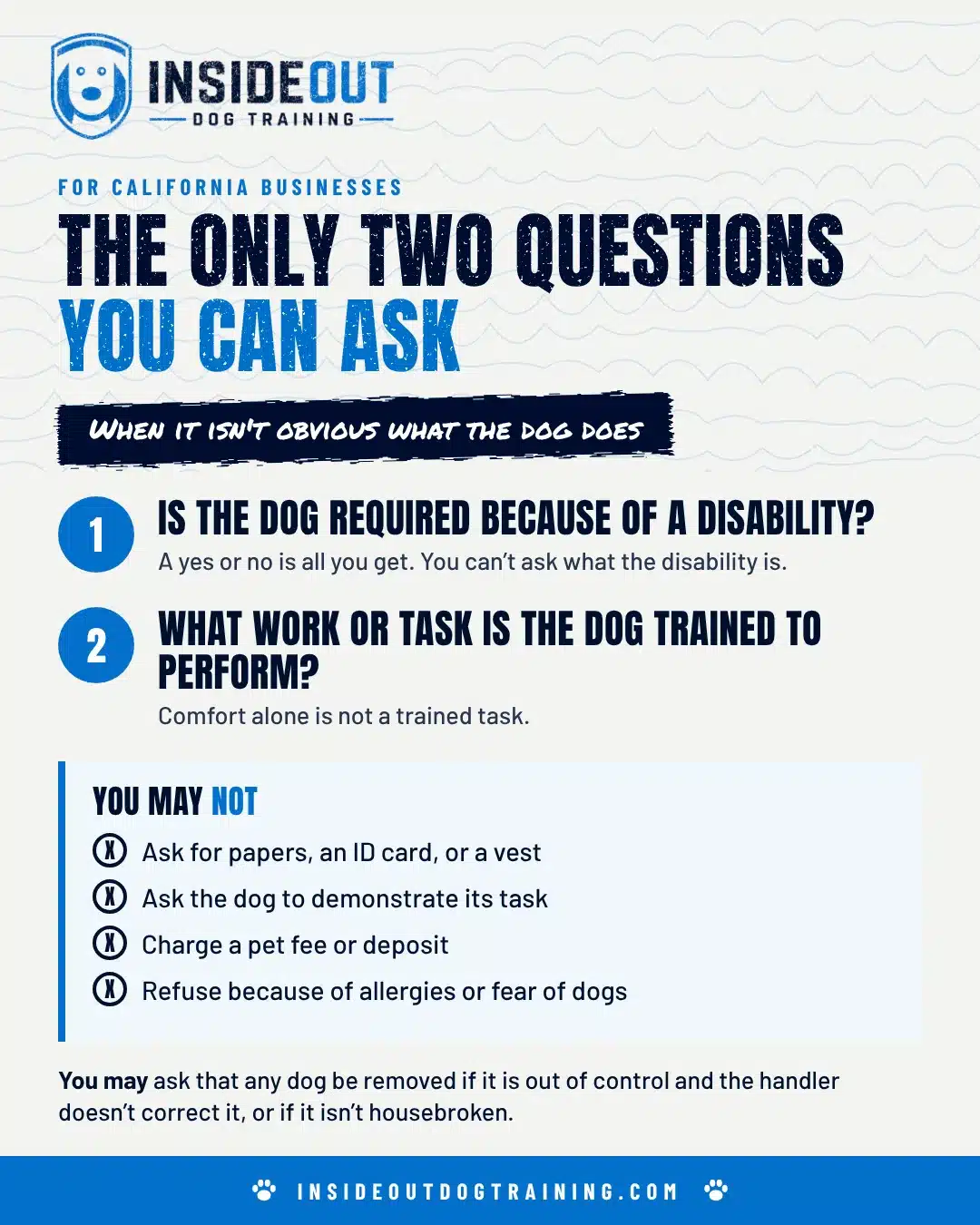
That’s it. You may not ask what the person’s disability is. You may not ask for papers, a card, or a vest, and you may not ask the dog to show off its task. Pet fees are out, parking the customer off in a corner is out, and somebody else’s allergies or fear of dogs is not a legal reason to turn the team away.
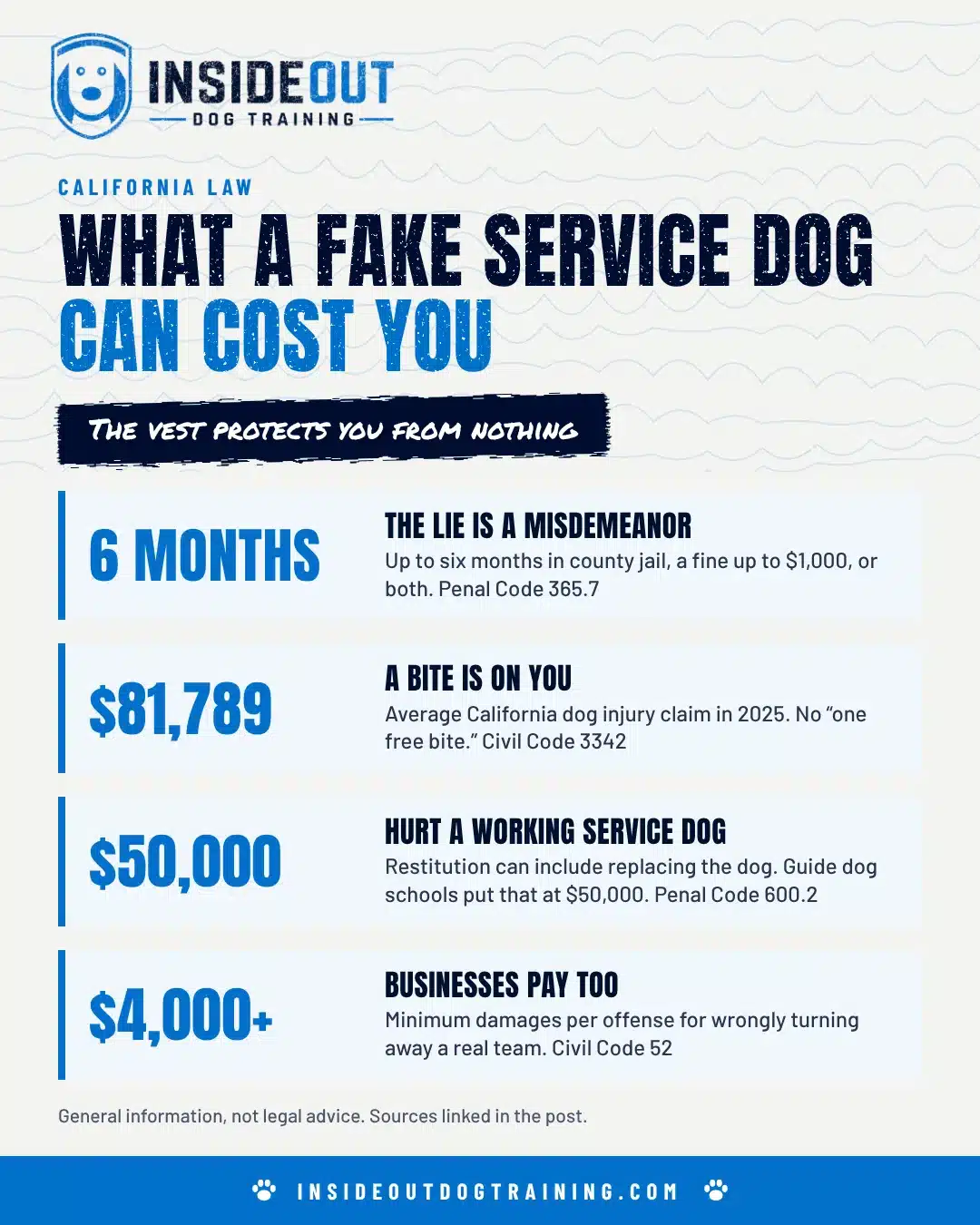
Getting this wrong is expensive. California’s civil rights law sets damages for a wrongful denial at no less than $4,000 per offense, plus the other side’s attorney’s fees.
Now here’s the piece most business owners don’t know, and it’s the one that matters most. You are allowed to ask that any dog be removed if it is out of control and the handler doesn’t get it back under control, or if it isn’t housebroken. That holds for a real service dog and a fake one alike. You never have to guess whether the dog is legitimate. You only have to watch what it does. A dog that’s lunging, barking over and over, or peeing on the endcap can be asked to leave, and you then offer to serve the person without the dog.
What a fake service dog can cost you
Alright, for anybody still thinking it’s no big deal.
The lie is a misdemeanor
California Penal Code 365.7 makes it a crime to knowingly and fraudulently claim to be the owner or trainer of a guide, signal, or service dog. The penalty is up to six months in county jail, a fine up to $1,000, or both. I’ll be honest that I couldn’t find folks being hauled in for it every week, so I’m not going to pretend the sheriff is waiting at the door of every store. It’s on the books, and that’s not even the part that should worry you most.
A bite is on you, no matter what the vest says
California doesn’t give a dog one free bite. If your dog bites somebody in a public place, you are liable for the damages, even if he has never so much as growled before. Calling him a service dog protects you from exactly none of that. The insurance industry counted 2,830 dog injury claims in California in 2025, averaging $81,789 apiece. If the bill runs past your policy limit, or your policy doesn’t cover the dog, the rest comes out of your pocket.
Hurting a real service dog is its own offense
California law makes it a crime to let your dog injure or kill a working guide, signal, or service dog, and a conviction comes with restitution. That means vet bills, the handler’s lost wages and medical costs, and if the dog can’t work anymore, the cost of replacing and retraining one. Guide dog schools have put the cost of raising and training a single dog at $50,000. You’d also have taken away a person’s independence for the year or two it takes to get a new dog ready.
The damage bill is yours too
Even real handlers pay for anything their dog tears up. Yours will be no different. And on an airplane, you sign a federal form swearing the dog is trained, and the form itself warns that lying on it is a federal crime.
It isn’t fair to your dog, either
This is my professional opinion after a couple of decades of doing this. A service dog spends months learning to ignore dropped food, screaming toddlers, rattling carts, and other dogs. The minimum standard one handler organization recommends is 120 hours of training over six months or more, with at least 30 of those hours out in public.
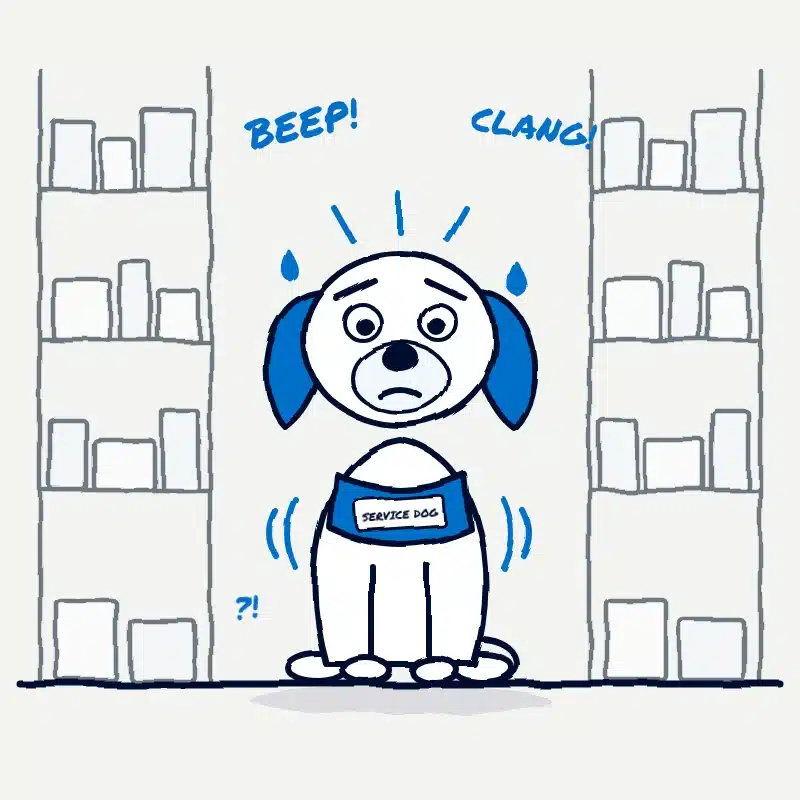
Your pet didn’t get any of that. So when you walk him into a loud, crowded store, he’s overwhelmed, and a dog that’s overwhelmed and has no way out is the one that barks, lunges, or bites. Then he’s the one who ends up with a bite on his record. You put him in that spot, and he never asked to go.
What to do instead
I’d a whole lot rather point you somewhere good than just holler at you.
If your dog is a comfort to you, that’s wonderful, and there are plenty of places that welcome pets. Patios, hardware stores, and pet supply shops will be glad to see you both, and you won’t have to lie to anybody.
If you have a disability and believe a service dog could help, you can do this the right way. You’re allowed to train your own dog, and a good trainer can help you teach the tasks and the public manners that make the difference. That’s work I do, and I’m proud of it.
If you just want a dog who’s a pleasure to take places, that’s training too, and private lessons or our board and train program can get you there.
And if you see a working team out in the world, give them room. Don’t pet the dog, don’t call to it, and don’t let your own dog walk up on it. My kids know the rule at our house: we never pet a dog we don’t know out in public. A working dog is the best reason there is for that rule.
Quick answers
Can a business ask for my service dog's papers?
No. Staff can ask whether the dog is required because of a disability and what task it’s trained to perform. They can’t require documentation, ID, or a vest.
Is my emotional support animal allowed in stores and restaurants?
Not as a legal right. ESAs are covered in California housing, but they don’t have public access to businesses the way a trained service dog does.
What's the penalty for a fake service dog in California?
Knowingly and fraudulently claiming a service dog is a misdemeanor, with up to six months in county jail, a fine up to $1,000, or both. Any harm the dog causes is a separate matter, and you’re liable for that too.
Can a real service dog be kicked out?
Yes, if it’s out of control and the handler doesn’t correct it, or if it isn’t housebroken. The business then has to offer to serve the person without the dog.
Does my service dog in training have public access?
In California, yes, if the dog is on a leash and wearing an assistance dog tag from the county or animal control.
Want to do this the right way?
If you’re in Apple Valley, Victorville, Hesperia, Adelanto, or nearby and want help with service dog training or just a dog you can be proud of in public, I’d be glad to talk it over.
About the author. Jason Rae, CPDT-KA, is the owner of InsideOut Dog Training in the High Desert and has been training dogs for nearly 24 years. This post is general information and is not legal advice.
