

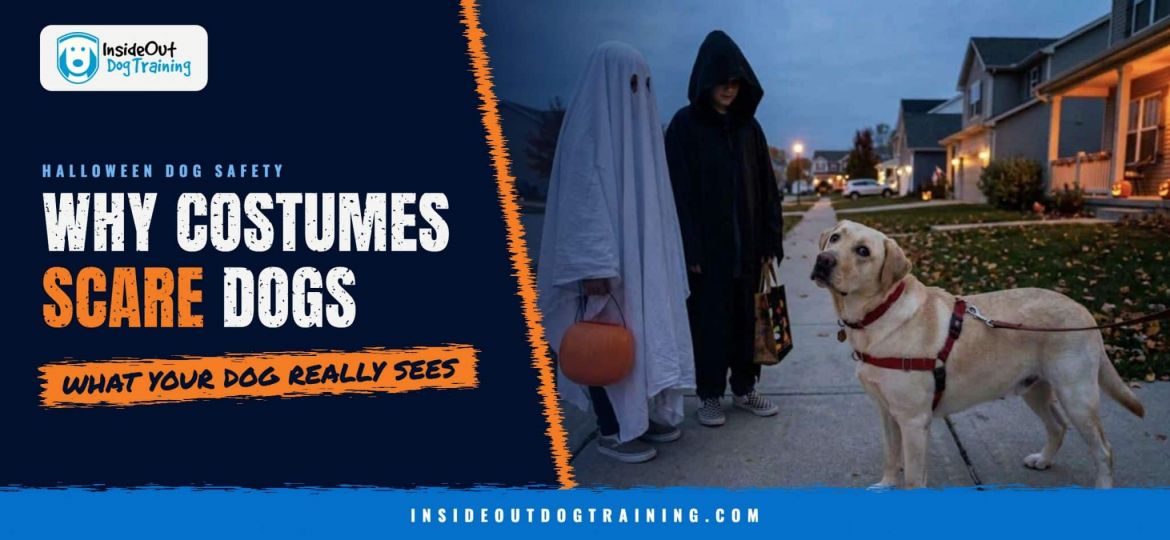
In my last post I told you that Halloween, for a dog, is like being stuck in a nightmare he can’t wake up from, with us holding the leash and walking him right through the middle of it. That might sound a little dramatic, so I went and dug into the science on how dogs see and what fear does inside of them. It turns out it isn’t dramatic at all, and it explains exactly why Halloween costumes scare dogs who are fine every other night of the year.
Once you understand what a dog’s eyes and brain are doing on a dark street full of masks, the nightmare makes perfect sense. Some of this surprised me, and I’ve been training dogs for nearly 24 years. This one runs a little long, but stick with me, because it will change how you see your dog on October 31st.
20/75
about how sharp a dog’s eyesight is
2 colors
blue and yellow, and that’s it
900 m
how far a dog can spot something moving
76%
of dogs look to their owner when something scares them
Why Halloween costumes scare dogs: start with what he sees
Most of what we know here comes from a big review of dog vision published in the Journal of the American Veterinary Medical Association by two veterinary eye specialists. I’ll give you the science first and then put it into everyday language, because the everyday version is where Halloween comes in.
He sees the world a little blurry
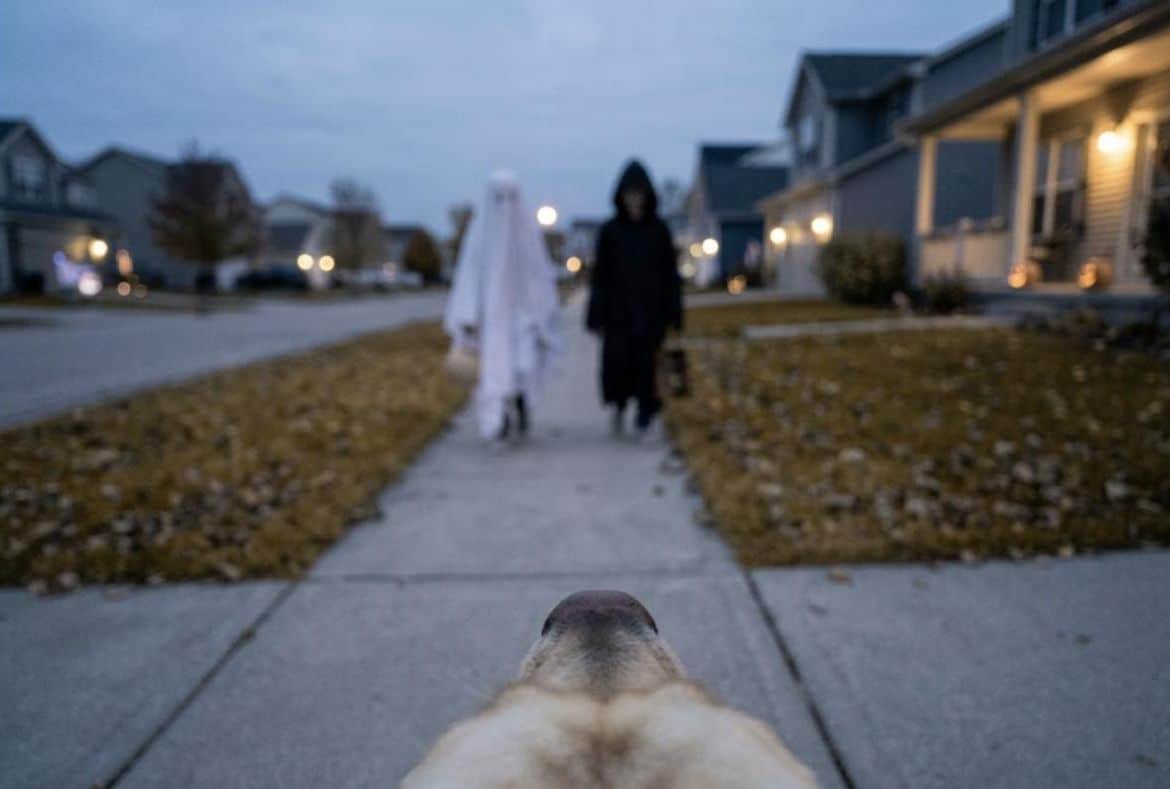
The researchers put a dog’s eyesight at roughly 20/75. In plain terms, something you can see clearly from 75 feet away, your dog has to be about 20 feet from to see as well. So that neighbor waving at you from across the street is a face to you and a fuzzy shape to him. He isn’t ignoring anybody. He just can’t make out who it is until they’re close, and on Halloween, by the time they’re close they’re already on top of him.
He sees two colors, not three
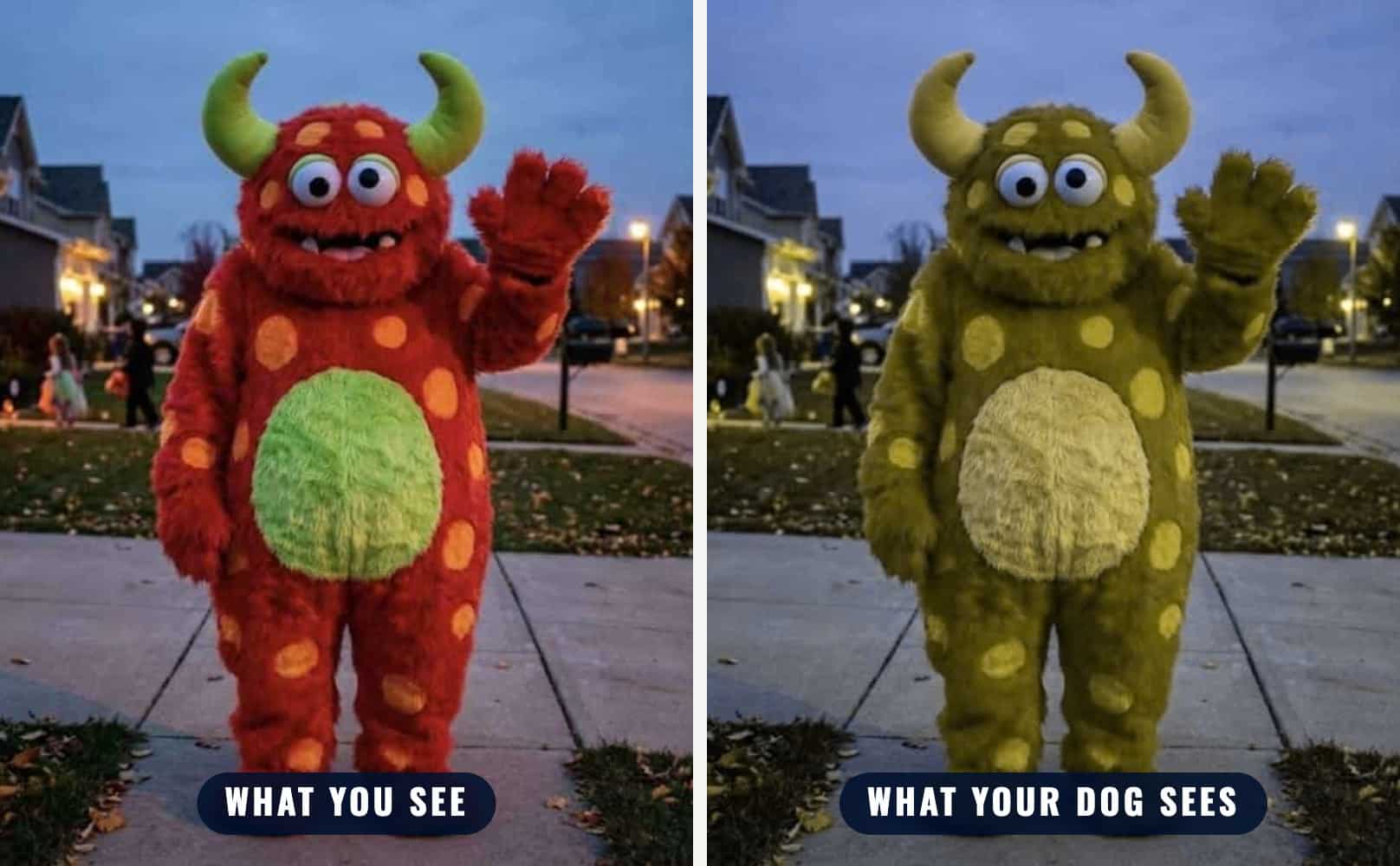
Dogs have two kinds of color sensors in their eyes where we have three. They see blues and yellows, and they can’t tell red, orange and green apart the way we can. That bright red devil and that green goblin that look so different to you are about the same muddy color to your dog. All the color we use to tell one costume from another, and to tell that it’s a costume in the first place, is mostly lost on him.
He sees better than you in the dark, but not sharper
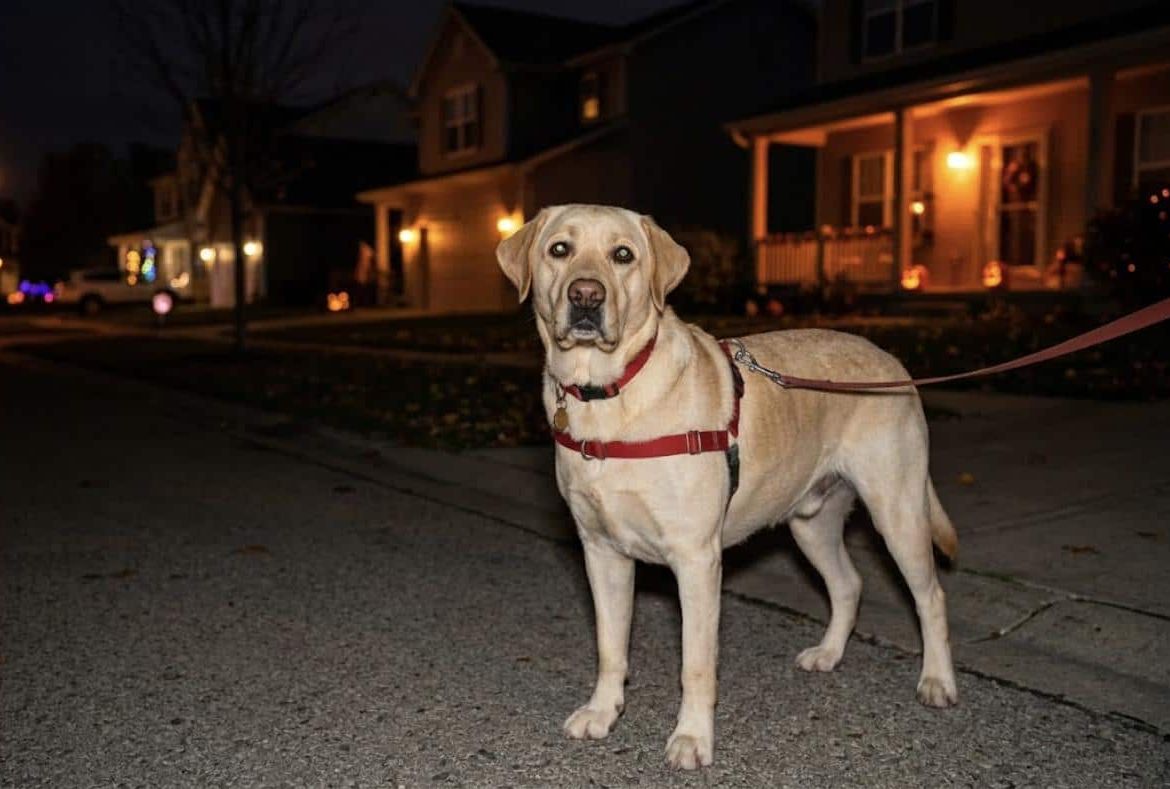
This is the part people get backwards. A dog’s eye is built for dim light. The center of his retina is packed with the cells that work in low light, and behind it is a reflective layer that bounces light back through a second time so he gets two chances to catch it. That layer is the same thing that makes his eyes glow in your headlights.
So at dusk he’s picking up more than you are. But more light doesn’t mean more detail. He’s getting a brighter picture of the same blurry shapes, which means he notices every figure on that street long before he can tell what any of them are.
He’s built to catch movement
Movement is where a dog’s eyes beat ours. In one old study of police dogs, the dogs could pick out a moving object from 800 to 900 meters away, and they could only recognize that same object standing still from about 585 meters or less. His eyes are tuned for things that move.
Now think about what moves on Halloween. Capes are flapping, sheets are billowing, kids are running in every direction and somebody’s yard skeleton is waving its arms. Every bit of that is the exact thing his eyes were designed to lock onto.
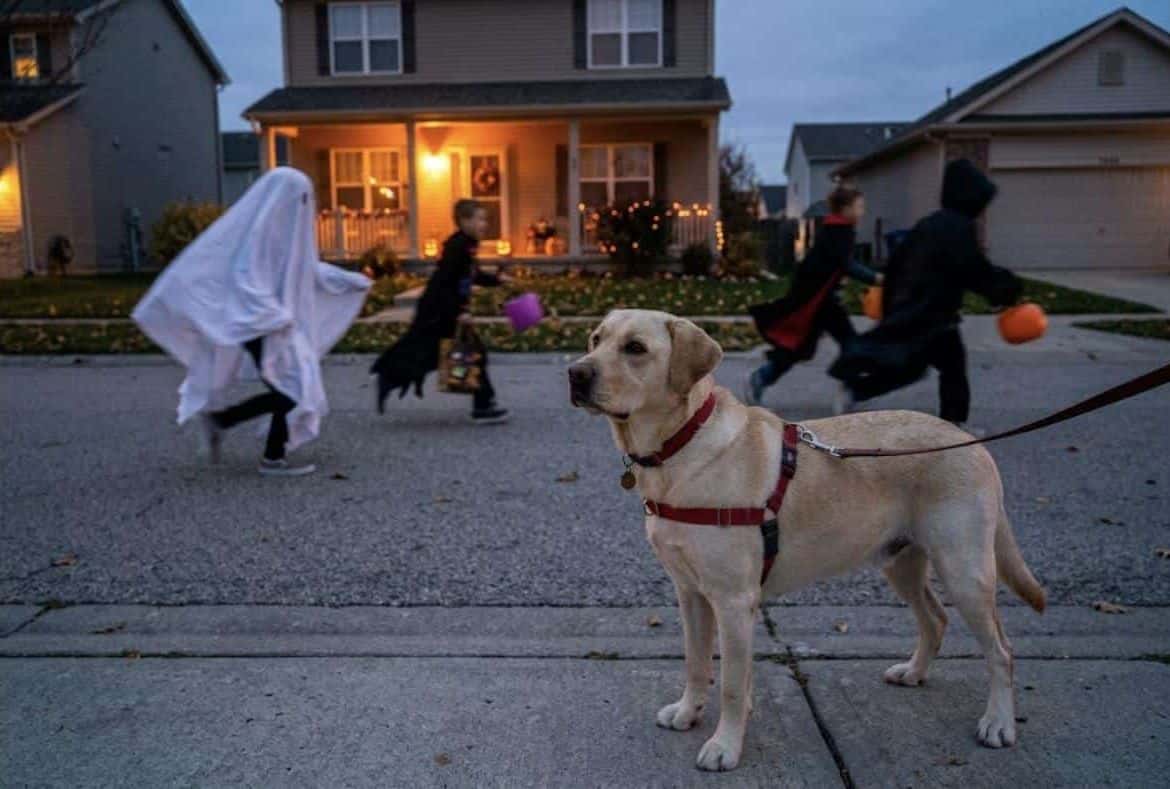
Put those four together and you’ve got a dog standing in the half-dark, seeing a street full of blurry, washed-out shapes that are all moving at once, and seeing them earlier than you do. That alone goes a long way toward explaining why Halloween costumes scare dogs, and we haven’t even gotten to the masks yet.
Why a mask erases the person he knows
This one is my favorite, because it explains something I’ve watched happen for years. Researchers in Italy tested whether dogs could pick out their own owner’s face from a stranger’s, and they published it in Animal Cognition. The dogs could do it, but only when they could see the outline of the person’s head. When the outline was hidden, they did no better than guessing, even with the eyes, nose and mouth in plain view.
A second group put dogs in a brain scanner and went looking for the part of the brain that handles faces. We have one. It lights up for eyes, a nose and a mouth. In the dogs, they couldn’t find it. The researchers think dogs lean on the shape of the head, the situation, and their other senses to work out who somebody is.
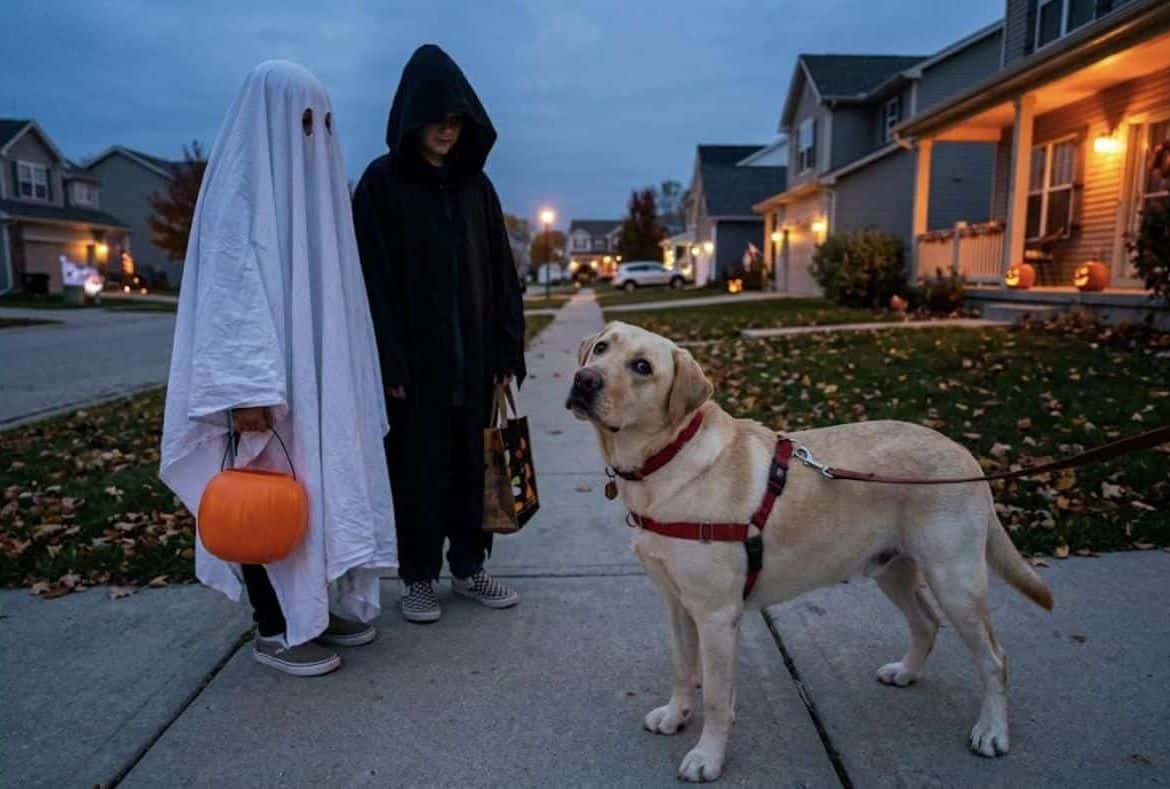
Now let’s put that into everyday language. Your dog knows you, and he knows the neighbor, mostly by the shape of your head and the way you carry yourself. A mask changes that shape. A hood hides it. A wig or a witch’s hat turns it into something he’s never seen, and a bedsheet ghost removes it altogether. As far as his brain can tell, the person he knew is gone, and something else is walking up the sidewalk toward him.
He still has his nose and his ears, and that’s why a dog will sometimes settle down once the person talks or gets close enough to smell. The trouble is that the shape reaches him first, and on Halloween there’s another one right behind it.
What fear does inside your dog
Dr. Karen Overall, one of the best-known veterinary behaviorists in the country, describes fear as a response of the nervous system, and what it looks like from the outside is avoidance. That matters, because it means your dog isn’t choosing to be scared and he isn’t being stubborn. His body has taken over.
Here’s what’s happening in there. When a dog decides something is a threat, his body dumps stress hormones. As veterinary behaviorist Dr. Valarie Tynes explains, those hormones send energy and oxygen to the muscles and shut down the jobs that can wait, like digestion. That’s fight or flight, and it’s why a scared dog often won’t touch a treat he’d normally knock you over for. His body has decided eating is for later.
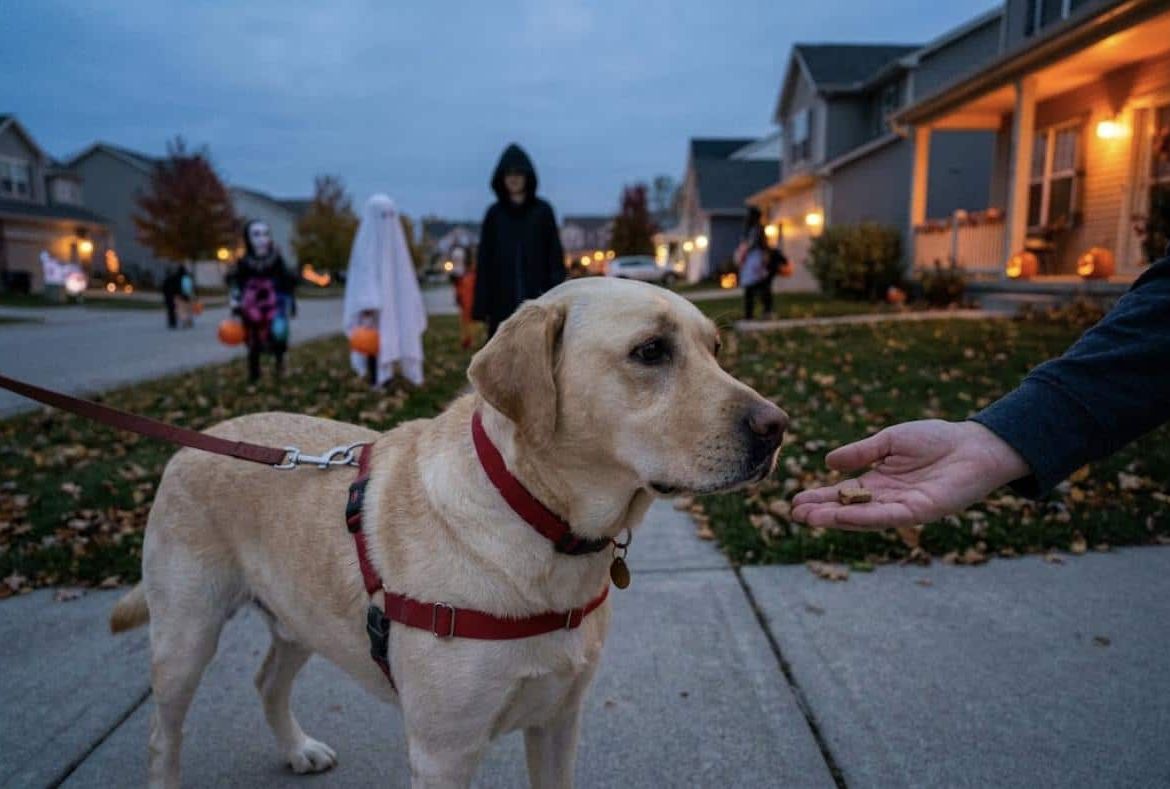
The second thing those hormones do is the one that worries me most. Dr. Tynes points out that memories formed while an animal is under stress are very powerful ones. The veterinary behaviorists at VCA say the same thing from the other direction: a single bad experience can create a lasting fear, and that fear can spread to anything that resembles it.
So on Halloween night you’ve got a dog whose body is flooded and ready to run, on a leash that won’t let him, and every scare that happens while he’s in that state is getting filed away as an important memory. That’s how one night turns into a dog who doesn’t want to walk after dark anymore.
Four ways we make it worse without meaning to
I spent over a decade working the behavior department in a shelter, and most of the fearful dogs I saw there weren’t made that way by one terrible person. They got there one well-meaning response at a time. These are the four I see the most.
1. We make him meet it
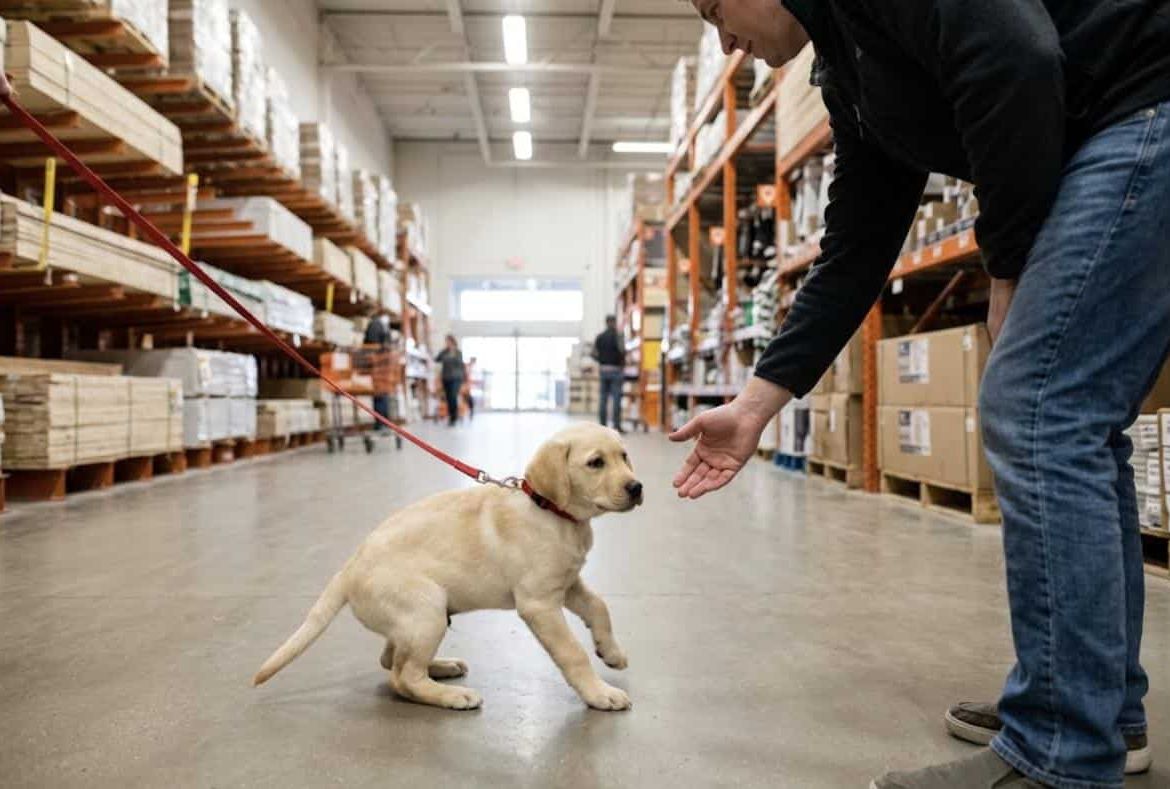
I was at Lowe’s one day with a client and her three-and-a-half-month-old puppy. Every time somebody came over to pet that puppy, he backed up. He was telling everybody in the only way he had that he wasn’t ready. His owner said “it’s okay” and held him there, the strangers said “it’s okay” and petted him anyway, and that whole trip was a nightmare for that puppy.
Everything about that picture is wrong, and Halloween is the same picture with a mask on it. When we walk a nervous dog up to a costume so he can “see it’s fine,” we’ve taken away the one thing he was asking for, which was distance. Don’t force him into it. Let him back up.
2. We fuss over him
In a study published in PLOS ONE, researchers showed dogs a strange object and watched what they did. About 76% of them looked back at their owner. When the owner sounded happy about it, the dog went up and checked it out. When the owner sounded worried, the dog hung back. Your dog is reading you to find out how bad this is.
So when something spooks him and we drop down with “oh my gosh, it’s okay, it’s okay, it’s okay” in that high, worried voice, we’ve just told him it is not okay. What I do is check on him, make sure he’s all right, and then stay calm and neutral and give him a minute to balance himself back out. There’s nothing wrong with a calm hand on him. It’s the fussing that does the damage.
Let me be clear about what I mean here, because this one gets misquoted. Petting a scared dog doesn’t create the fear. The research is solid on that, and the fear was already there before you touched him. What I’m talking about is the behavior that’s happening while he’s scared. If he bolts and hides, or climbs up your leg shaking, and that’s the exact moment the petting and the baby talk show up, he makes a check mark that says acting like this gets me all of that. Do it enough times and you’ve built a habit on top of the fear.
I’ve got five kids, and I tell clients the same thing I tell them. Sometimes I love you enough to say no. I love you, son, so no, you can’t stay out past midnight. With a dog it’s the same idea. I love you enough not to make a big production out of this, because you need to learn you can get through it.
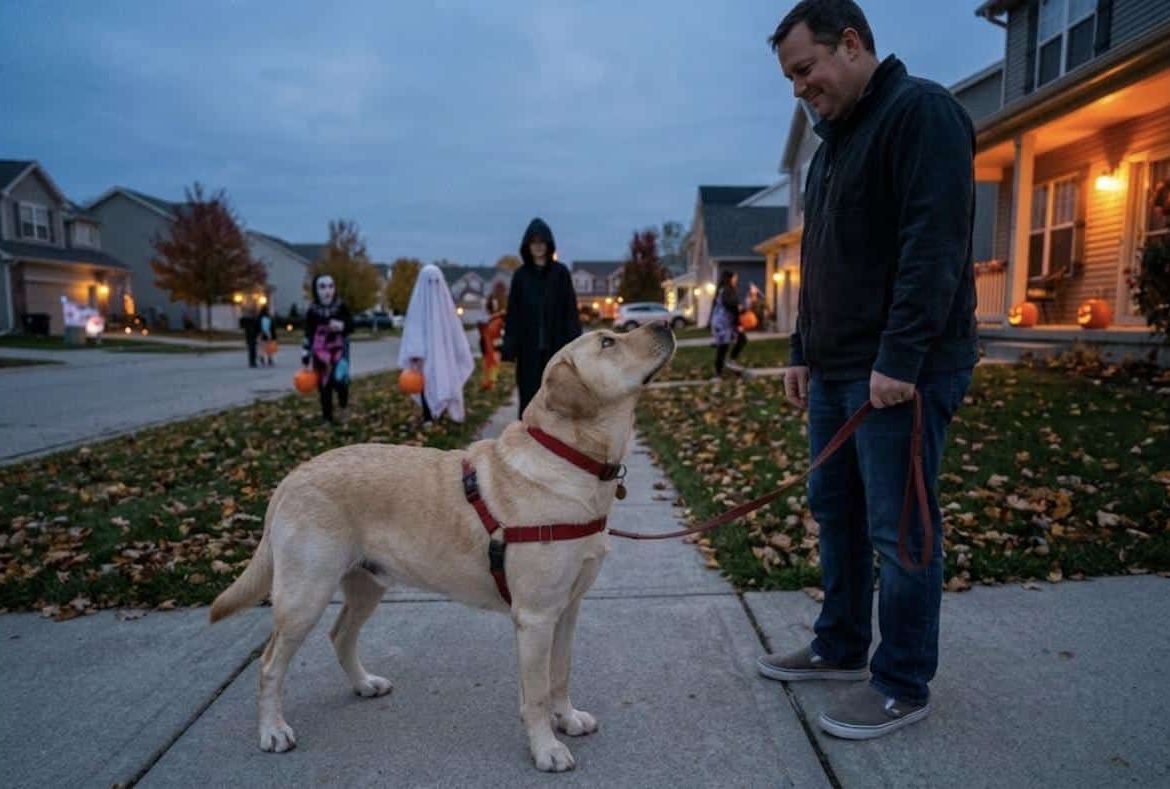
3. We correct him for it
The other side of fussing is getting after him. He barks or lunges at a costume, we’re embarrassed, and we pop the leash or scold him. VCA’s behaviorists are plain about what that does: he gets more afraid of the situation, and he can start being afraid of being close to you. Dr. Overall says punishment should be avoided because it gives a dog no useful information. He already thought that goblin was bad news, and now it comes with you being mad at him too.
4. We teach him that growling works
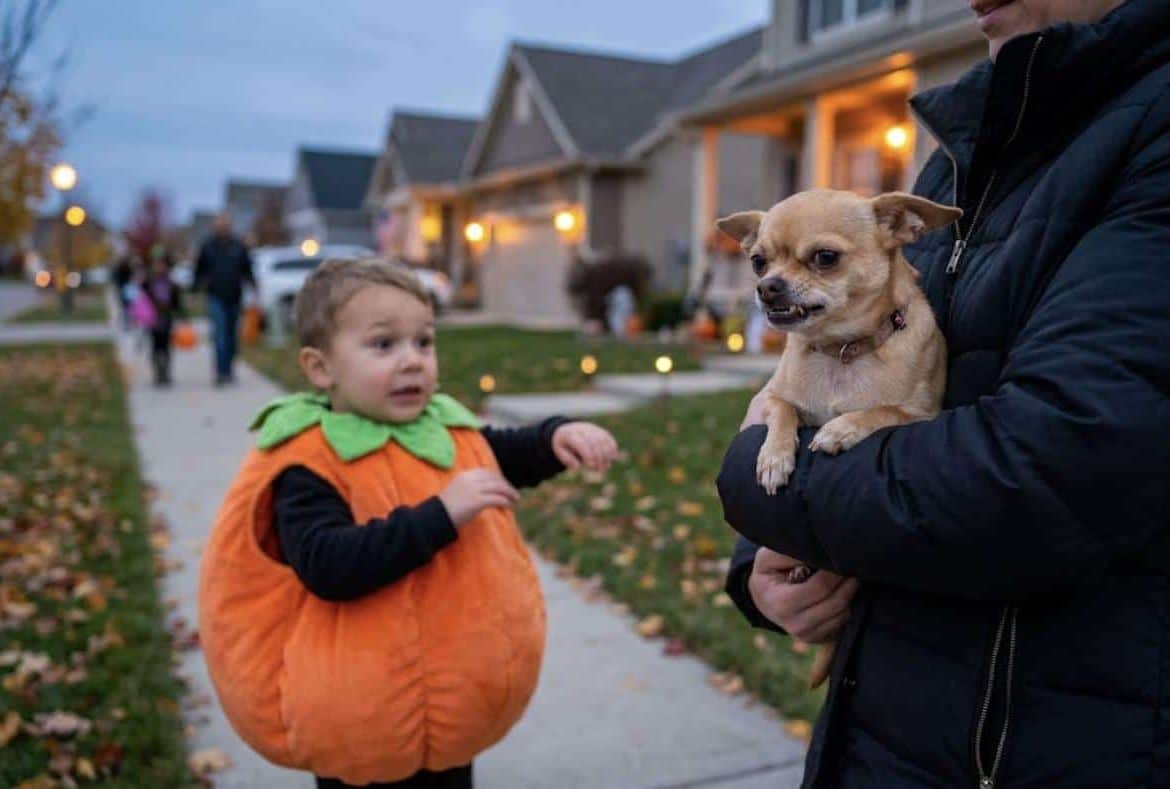
I call this one the Chihuahua Effect, because I see it all the time with little dogs. Somebody reaches for a small dog in his owner’s arms, he’s scared, and he growls. The owner pulls the person’s hand away and soothes him. What the dog just learned is that a growl makes the scary thing back off. Do that enough times and the day somebody doesn’t back off, the growl becomes a nip, and then everybody says he’s a mean dog. He isn’t. He’s doing exactly what we taught him.
Halloween will teach that lesson in one night. A kid in a costume gets too close, your dog growls or barks, the kid jumps back, and your dog makes a little check mark. That worked. Multiply that by forty trick-or-treaters and you’ve given him a whole semester of practice.
What to do instead on Halloween
The simplest answer is the one I gave you last time: leave him home. I laid out ten reasons in my post on taking your dog trick-or-treating, and my Halloween dog safety guide shows you how to set up a quiet room and get through the doorbell.
If he does get scared, whether it’s on the porch or out on a walk that week, here’s how I handle it. I check that he’s okay, I keep my own voice and body calm, and I give him distance from whatever it was. Then I watch how fast he recovers. A dog who startles and is wiggling and sniffing again thirty seconds later is fine, and we carry on. A dog who can’t settle back down is over his limit, and we’re done for the night. I take him home and I don’t feel one bit bad about it.
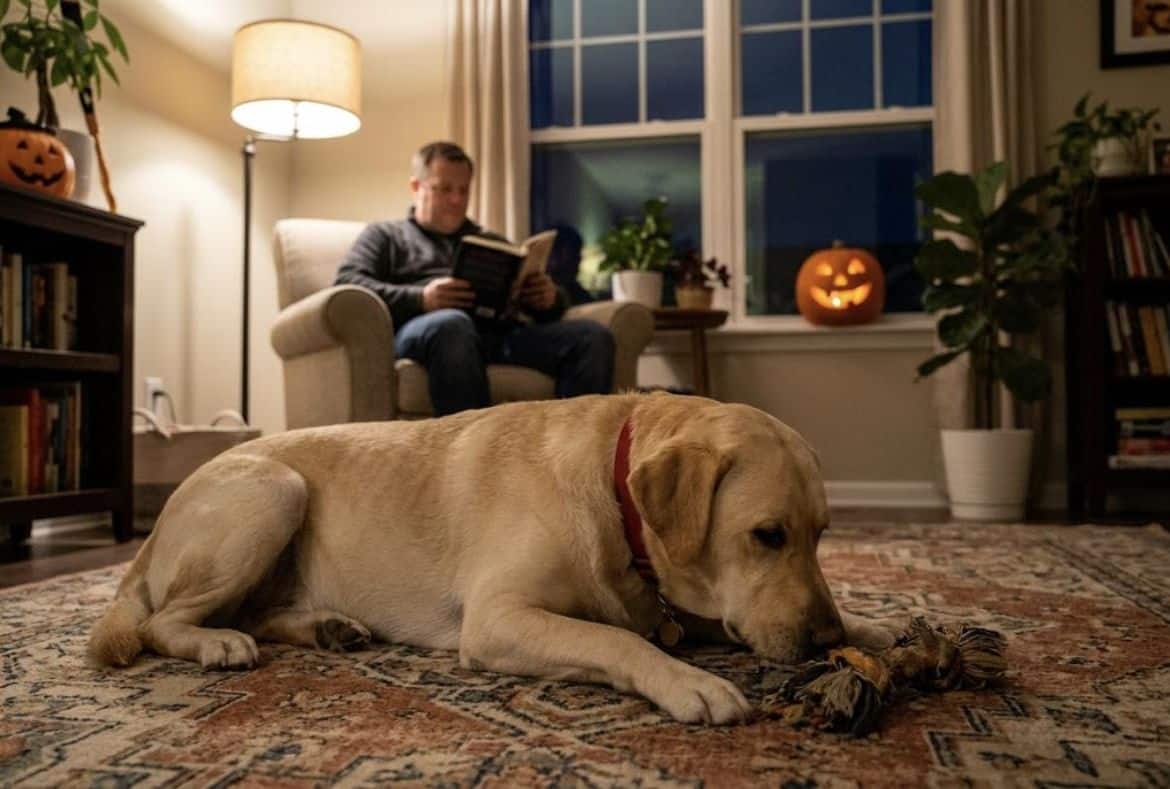
Dr. Overall has a line I come back to a lot. She says that if you do nothing but avoid the situation, the great majority of animals get better. Avoiding the thing that scares him isn’t giving up on him. Most of the time it’s the fastest way to help.
When a scared dog needs more help
Some dogs are born more fearful than others, and it has nothing to do with how they were raised. If your dog’s fear is getting worse, if he’s growling or snapping, or if he can’t recover after something scares him, that’s past what a blog post can fix. Talk to your veterinarian to rule out pain or a medical cause, and work with a qualified trainer or a veterinary behaviorist who doesn’t use fear or force.
Questions I get about why Halloween costumes scare dogs
Why is my dog scared of people in costumes?
Dogs recognize people largely by the outline of the head and the way they move, and a costume changes both. Add blurry eyesight, limited color and low light, and a person he knows can look like something he has never seen before.
Can dogs see in the dark?
They see better than we do in dim light, because their eyes are built to gather more of it. They don’t see more detail, though, so at night your dog notices shapes and movement sooner than you do without being able to tell what they are.
Should I comfort my dog when he’s scared?
Check that he’s okay and stay calm. A steady hand and a normal voice are fine. What I’d avoid is anxious fussing, because your dog reads your tone to decide how worried he should be, and I’d never force him toward the thing that scared him.
Will my dog get over a Halloween scare?
Many do, especially if he recovered quickly and you gave him space. If he’s still jumpy on walks or around strangers a couple of weeks later, that’s worth working on, and our private lessons are where we do that.
Is your dog fearful or reactive?
If your dog is scared of strangers, jumpy on walks or reactive around people, that’s exactly the kind of thing we help with. I train dogs and their people in Apple Valley, Victorville, Hesperia and Adelanto, and the first visit is a free consultation so we can meet your dog and talk about what’s going on.
Jason Rae is a CPDT-KA certified dog trainer with nearly 24 years of experience and the founder of InsideOut Dog Training in Apple Valley, CA. He also founded Strutmymutt.com, a free training platform for shelters and rescues. This article is general education and is not veterinary advice.
